Robert Morales
April 22nd 2026
Professor Meeker.
Conference Paper Essay
Misogyny in Women’s Sports
Misogyny in sports has long shaped not only the opportunities available to women athletes but also the ways their performances are perceived and valued. Nowhere is this more evident than in women’s basketball, where players consistently face disparities in media coverage, pay, and public respect when compared to their male counterparts. While leagues such as the WNBA have grown in visibility and talent, cultural narratives continue to frame women’s basketball as inferior or less entertaining than men’s basketball. This essay examines how scholars have analyzed the intersection of gender, media representation, and institutional inequality within the sport. By comparing perceptions of women’s basketball to those of men’s basketball, this paper highlights how misogyny operates both overtly and subtly, reinforcing broader societal hierarchies. Ultimately, the existing research reveals that the marginalization of women’s basketball is not a reflection of athletic ability but rather the product of deeply rooted gender biases that continue to shape the sports landscape. My main thesis for the paper is that despite the massive increase in Legislation and participation in women’s sports, misogyny is still present in digital Sports culture due to the lack of media coverage negative perceptions of women’s basketball through sexism and racism as well as maintaining its certain economic structures and as a result it reinforces the deeply rooted gender biases that continue to shape its cultural and digital landscape.
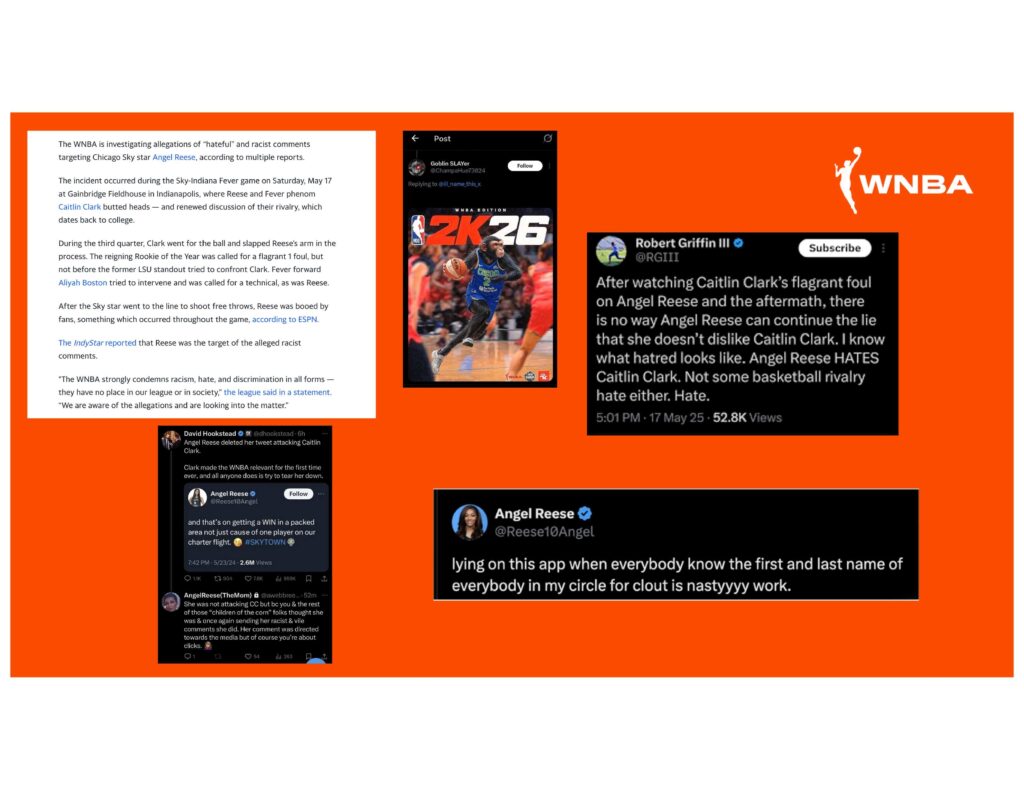
As stated earlier, women’s sports across the board are on the rise, but perhaps the leader of this movement is women’s basketball, particularly in the college basketball and WNBA scenes. However, with this rise across the board digital sports media culture, with women’s college basketball and the WNBA as a result, it rises as well. While it is definitely a good thing that more people are talking about the product of women’s basketball as a whole online, it is also given Misogyny as a structure and as a system of empowerment to really spread bigotry and hate towards women’s sports, and in this case, high-level basketball as well. The two most well-known basketball players and leaders for women’s basketball throughout the early 2020s are Caitlin Clark and Angel Reese. Both high-level basketball players played for the University of Iowa and LSU, respectively. Both players, because they’re so good at their craft and have a competitive nature and desire to win basketball games, had a bit of a rivalry throughout their college basketball careers. The reason why athletes like Caitlin Clark and Angel Reese and their rivalry throughout their basketball careers is relevant when it comes to having a conversation about the rise of misogyny when discussing women’s sports in digital media culture, and as a result of this rivalry, we see misogyny and racism intertwine. A study on digital sports culture shows how misogyny in women’s basketball is reinforced through online discussions, particularly in male-dominated spaces, analyzing players like Caitlin Clark and Angel Reese. The authors argue that these spaces diminish women athletes by portraying them through gendered stereotypes and framing their games as less legitimate, while also applying racialized stereotypes to Black players like Reese. Ultimately, the study demonstrates that negative perceptions of women’s basketball are socially constructed through intertwined sexism and racism rather than reflecting the sport’s actual quality. According to the said article, Manufacturing Racialised Misogyny in China’s Digital Manosphere, yet, unlike the far-/alt-right pathways to misogyny and racism in Western societies, this discourse displays distinctive characteristics informed by China’s localised gender power dynamics and context-specific nationalist interpretations of the global racial order. On a platform predominantly frequented by male sports fans, this discourse illustrates the prevalence of gender- and race-based discrimination in present-day China and its dialectical relations with popular cultural consumption, nationalism, and international geopolitics.” The key argument when having misogyny and these discussions is not just an individual hostility towards specific women, but it’s part of a broader cultural and political structure and system. Users as a whole tend to frame women athletes through stereotypes such as the portrayal of women as very “over emotional”, “jealous”, or incapable in comparison to their male counterparts. This, as a result, reinforces traditional gender hierarchies; on top of this, racial bias is also layered on top of this misogyny when having a conversation or how black athletes like injuries are being discussed in sports digital media culture. Black women are often subjected to racialized stereotypes that show them as aggressive or threatening, showing how gender and race work together to shape negative perceptions of these women. The article also highlights that online discourse plays a role in spreading these ideas of massaging and racism in its interactions between the two. even phrases that are most associated with female solidarity, or twisted into sarcasm, or Expressions that mock women. These kinds of patterns are not really random; they reflect larger nationalists and political ideologies and narratives, particularly within countries like China and Western countries as well, and overall, the use of online platforms to spread this kind of hurtful ideologies can amplify anti-feminist and exclusionary discourse. Overall, the study that was sourced earlier argues that digital Sports media culture around women’s basketball can act like a space where misogyny and racism are normalized, rather than just affecting opinions about said sport. These discussions review deeper truths about the power structures and tensions of culture that shape how women athletes are perceived.
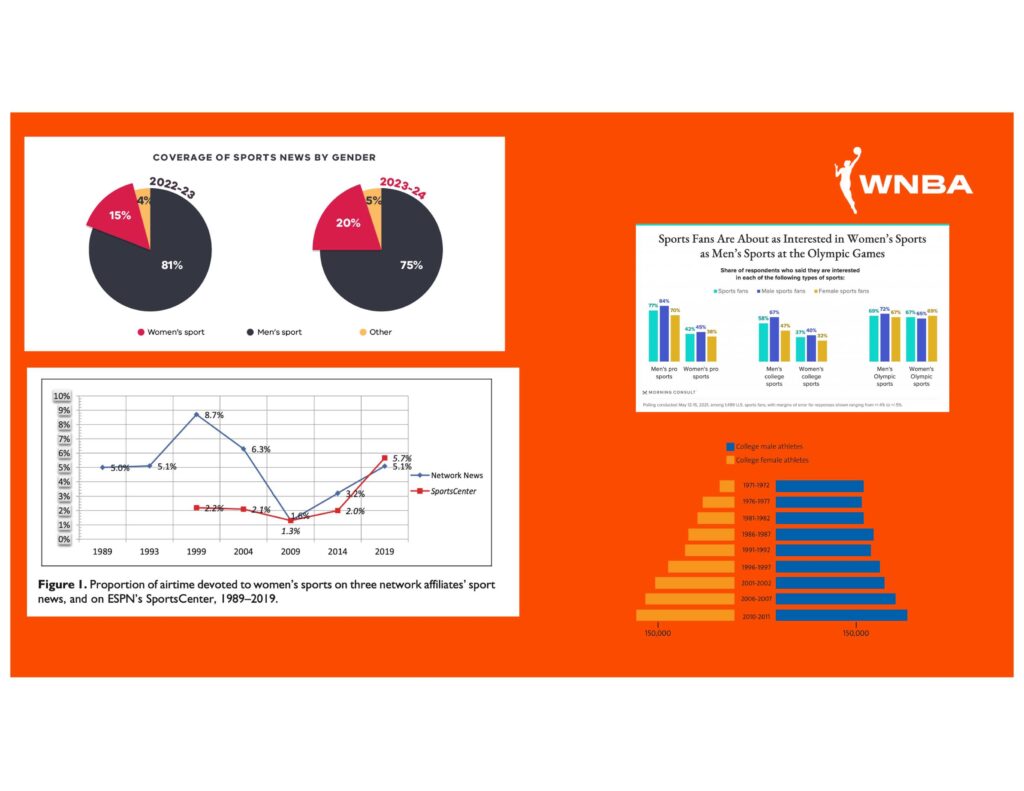
Another key argument that is very prevalent when discussing the presence of misogyny and women’s sports is the lack of media coverage/representation despite the advancements in participation and legislation. To further elaborate on what I mean, I first must start with an article that examines how sports journalists in other countries view women’s sports media coverage. In the article “The Perception of Women’s Sports by Polish Sports Journalists.” The article examines how journalists’ perceptions contribute to the marginalization of women’s sports. Through interviews with Polish sports journalists, the study finds that many view women’s sports as less important or less engaging, often justifying limited coverage as a reflection of audience interest rather than gender bias. Ultimately, the research shows that these attitudes reinforce systemic inequality by normalizing the idea that women’s sports are secondary to men’s, shaping public perception and limiting growth. A key concept of this article and why the citing of this article is very important is that male and female journalists don’t really recognize that gender bias that’s at play when it comes to the lack of coverage of women’s sports; they justify it as kind of very natural or very audience-driven in a sense. And what’s really interesting about this article is that even though female journalists, despite living and understanding what it’s like to be a woman in a huge male-dominated industry like sports, a lot of those same misogynistic believe so that gender biased is internalized as a result of working in this male-dominated field and being socialized into its cultural norms. According to the article, it states that “The coverage of women’s sports remains small despite the continuous increase in the number of girls and women taking part in sports. In the last 20 years in Poland, we observed an increase in adult sport participation from 30% in the 1990s to approximately 60% in 2013, with a steady 5% difference between the number of men and women participating (Lenartowicz, Dziubiński, & Jankowski, 2017). One of the possible reasons for the inequitable coverage of women’s sports is the male hegemony in sports media. While the proportion of professional male and female sportspersons has changed much in favor of the latter, sports journalism remains a profession dominated by men” This is crucial really understanding the lack of representation because the reality is as much as we seen growth and women’s sports the reality is is that sports has always been a male hegemony as the article describes and this quote best represents how the study argues how the media represents women’s sports are most definitely deeply rooted in gender biases within journalism and it reinforces this idea that women’s sports always be secondary to the men’s sports.
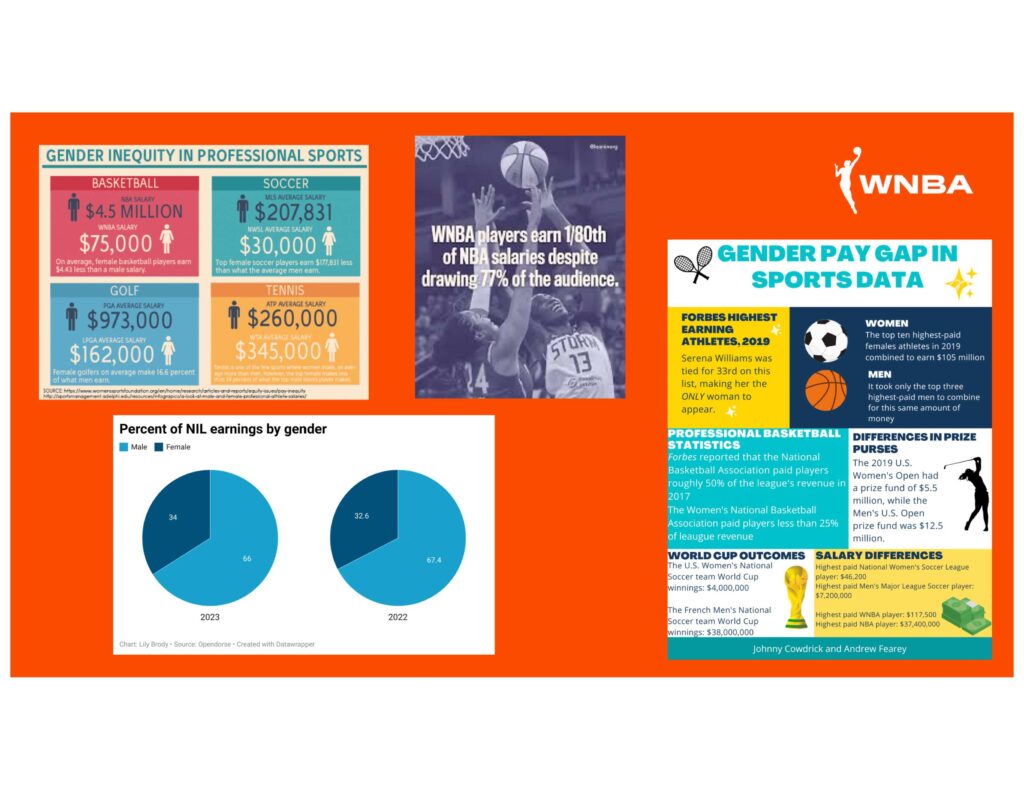
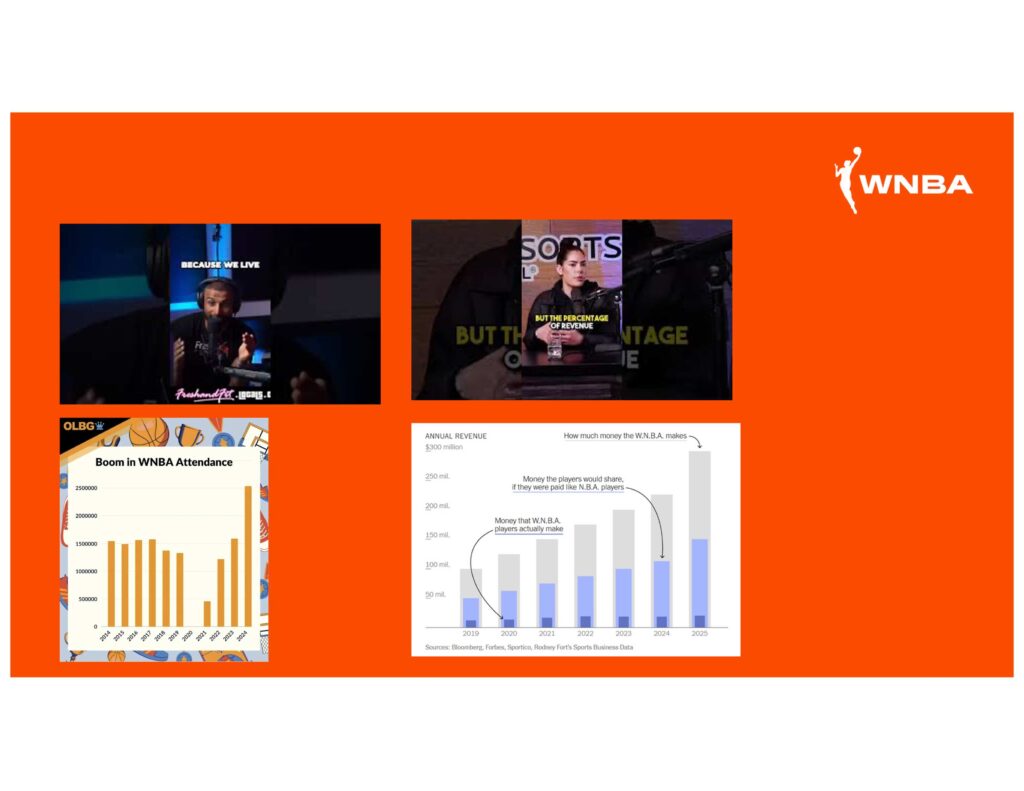
Inequality when it comes to pay between women and men is a topic that goes beyond Sports. There’s a topic in conversation that transcends centuries upon centuries of women in the workplace and how constantly they are undervalued doing the same line of work as their male peers. Today, women earn 80 cents to the man’s dollar, while it is definitely a progression from the years of yesteryear, it is still not good enough, and we see this in the sports world, but arguably even worse fashion. In “Bet on Women” from Building the WNBA, Georgia Munro-Cook argues that the wage gap in the WNBA is not simply due to revenue differences but is shaped by structural inequality and misogynistic attitudes that devalue women’s sports. She highlights how players and the Women’s National Basketball Players Association challenge this system by asserting their worth and demanding greater investment, reframing themselves as valuable labor rather than beneficiaries of opportunity. The chapter ultimately shows that limited pay and investment are part of a cycle where negative perceptions of women’s basketball suppress its growth, reinforcing broader gender inequality. Cook makes an excellent point when discussing the limited and structural factors that lead to inequality, and when you read the quote, it goes hand in hand with the main argument from the previous paragraph. Cook states how “The WNBA is assumed to be unpopular and salaries low due to the quality of play or intractable market forces. The structural factors that prevent women’s leagues from succeeding are ignored, supporting Allison’s (2018, p. 138) argument that ‘in professional sports today, essentialism operates as an “ideology of interest” that moves responsibility for inequality from sports, media, and corporate organisations and their constituent decision makers onto sport fans.’ In other words, the onus is on individual sport fans and the players themselves to support and grow the league, ignoring the lack of investment by brands or the media. ESPN, for instance, despite televising the WNBA, rarely talks about games or shows highlights on its talk shows, assuming a lack of interest yet not doing the work to build an audience in the same way it does for other sports or even poker tournaments. Early in the second paragraph, I state a key argument that the lack of attention women’s sports as a whole get in comparison to their male counterparts, despite the growth in women’s sports. However, in this quote, Cook is essentially saying that the ideology of the interest’s argument that moving responsibility from the sports media to the consumer in order to grow the league is a huge part of why the economic structures are the way that it is. Women are meant to be paid less than men because that is the way Society is structured as a whole. Rather than people in high positions of power, like Adam Silver, who is the commissioner of the parent company of the WNBA, taking accountability and really growing the league as a product. Despite the common media narrative that the wage Gap is simply because of Revenue differences and how the league isn’t profitable. Cook is arguing that it is sustained by misogynistic attitudes from the media and fans as a structure that, in turn, devalues women’s sports and limits Financial investment in the League like the WNBA. Preventing the league from reaching its full economic potential. As well as highlighting how WNBA players are expected to not only perform at an elite level, but in order to promote the league, it has to conform to gender expectations in order to gain visibility for the league as well. World-class athletes, such as women playing in the WNBA, should not settle for being grateful to have a professional league, as Society has kind of deemed this to be the narrative to be placed on Women and their sports.
Overall, this research reveals that misogyny in women’s basketball is sustained through interconnected systems of media representation, economic structures, and cultural attitudes. Across different contexts, women athletes are consistently undervalued, whether through limited coverage, wage disparities, or stereotypes that question their legitimacy. These studies demonstrate that negative perceptions of women’s basketball are not based on athletic ability but are socially constructed through sexism and, at times, racism. Taken together, this research underscores the need to challenge these narratives to create more equitable recognition and investment in women’s sports. Not only in terms of sports, but the research on inequality between men’s sports and women’s sports signifies a broader theme of gender inequality as a whole, regardless of the various contexts that may exist where there are gaps between men and women. I hope that this paper and research contribute to the overall conversation of misogyny and interconnected factors of online digital media representation and fan discourse, as well as addressing economic disparities and structures that continue to keep women limited in their growth and valuation.